Something arrived wrong
Torn pouch, soft puck, missing bowl. Send the lot code from the lid and we replace it — no photo, no argument.
replace@koridashi.example
Protocol · storage · shipping · questions
Almost everything that goes wrong with a rebloomed bowl is water temperature or water volume. The protocol below fixes both; the rest of this page covers everything else.
Four moves. The third one is the only one people get wrong.
Bring water to a full rolling boil — 100 °C at sea level. Electric kettle, stove, camp stove: the source doesn't matter, the temperature does.
Open the pouch, leave the puck in the bowl, pour boiling water to the embossed fill line (400–430 ml, printed per bowl). Cover with the lid.
Set a timer. Not 60, not 180. At altitude above 2,000 m, add 20–30 seconds.
One full stir from the base of the bowl to re-suspend the tare, and eat. The egg is at the bottom; rescue it first.
The crystal fills as the bowl blooms. Sixty seconds leaves a dry noodle core; three minutes softens it past the point of return.
1:30
Lid on. Do not stir until the timer ends.
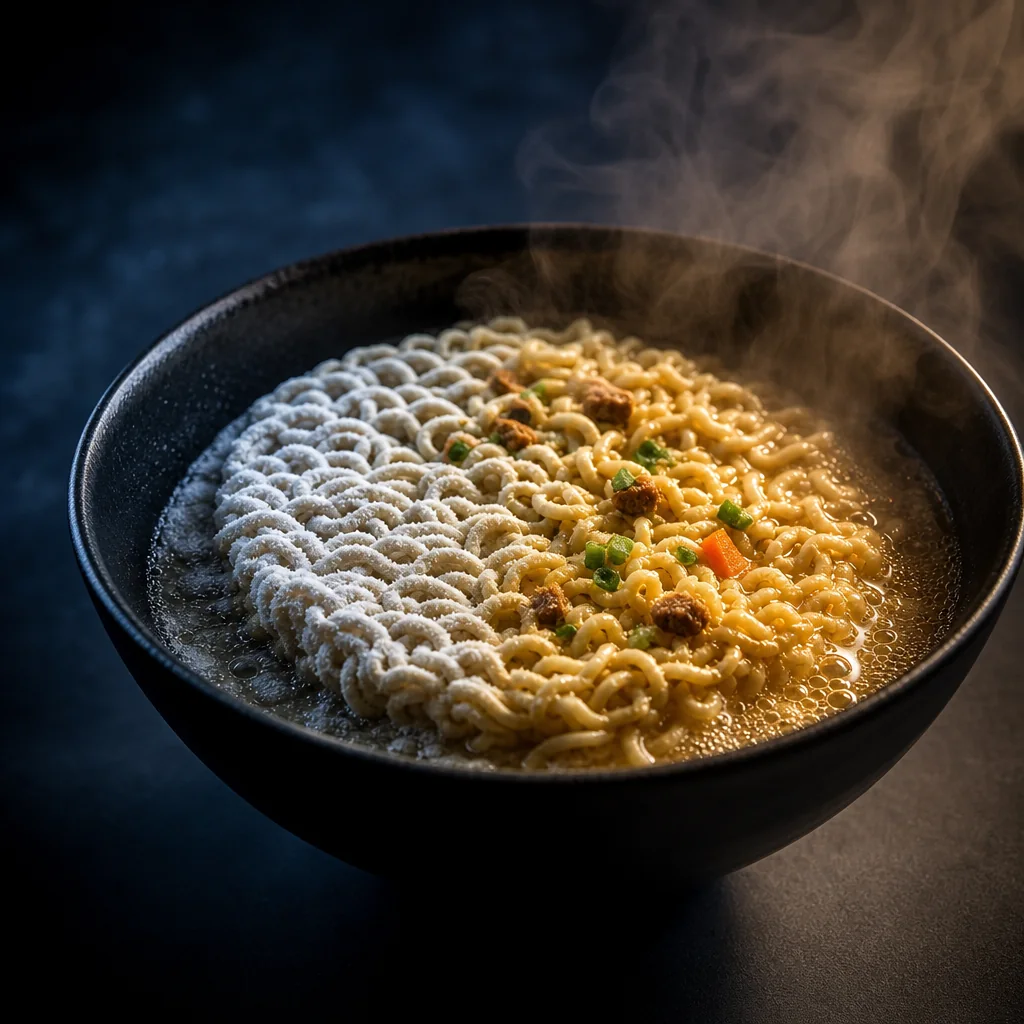
Second 40 · broth re-emulsifying
Two causes, both fixable. Water below 95 °C will not re-suspend the fat, so it stays in visible flakes — reheat and it will not recover, so start with a hard rolling boil. Too much water thins the tare: every bowl is seasoned for its exact volume, and the fill line inside the bowl is the volume we tested.
| Shelf life | 24 months from production, printed per lot |
|---|---|
| Temperature | Below 27 °C. No freezer, no fridge — they add nothing |
| Light | Keep pouches out of direct sun |
| After opening | Rehydrate immediately; the puck pulls moisture from air within hours |
| US (48 states) | USPS/UPS Ground, 2–5 business days, ambient — no cold chain |
|---|---|
| AK · HI | USPS Priority, 3–6 business days |
| Canada | 5–9 business days, duties included at checkout |
| Free shipping | Orders over $60 |
| Dispatch | 1–2 business days from Georgetown, Seattle |
Ten, in the order they arrive
The noodle lattice rehydrates from the outside in at a known rate: at 100 °C, a 1.3 mm noodle reaches full core hydration between 80 and 95 seconds. Shorter leaves a dry core; past 3 minutes the noodle keeps absorbing and softens. 90 seconds is the tested center. Set a timer — the difference is real.
Yes — 100 °C at sea level, a full rolling boil. At 95 °C, add 15 seconds. Above 2,000 m altitude water boils cooler, so add 20–30 seconds and stir at the end. Warm tap water will not rebuild the broth emulsion; the fat stays in flakes instead of re-suspending.
It's printed on every lid — 400–430 ml depending on the bowl. Use a marked vessel the first few times. Too much water thins the tare; the bowls are seasoned for their exact volume. The inner wall of the shipping bowl has a fill line.
Really. Sublimation removes 98.6% of water content, and we seal each bowl with an oxygen absorber in a nitrogen-flushed pouch at under 2% residual O₂. No water activity plus no oxygen means nothing to spoil. Store below 27 °C, out of sunlight. The freezer adds nothing.
A slightly domed pouch at altitude (air freight, mountain delivery) is pressure differential, not spoilage — our pouches leave the line under mild vacuum. If a pouch is torn, or the puck inside has gone soft or sticky, don't eat it; email support with the lot code and we'll replace it.
No — that's the point. Bowls ship ambient in a paperboard case, USPS or UPS Ground, anywhere in the US. Orders over $60 ship free. No ice packs, no dry ice, no doorstep race. Current dispatch time is 1–2 business days from the Georgetown facility.
Canada now (5–9 business days, duties included at checkout). EU and Japan are in customs review — join the waitlist from the cart page and we'll email when your country opens. Freeze-dried meat products cross borders slowly; we'd rather do it correctly than quickly.
No. Every bowl is cooked complete — broth, noodle, toppings — exactly as we'd serve it, then frozen at −41 °C and sublimated whole for 22 hours at 0.0004 atm. There is no seasoning sachet because the seasoning is already in the bowl. Cup noodles are flash-fried and rebuilt from parts; this is the finished dish, paused.
Every bowl contains wheat (noodle) and soy (tare). Eggs, pork, chicken, fish (dashi), sesame, peanut, and dairy vary by bowl — the full matrix is on each product page and printed on the lid. Kinoko Shio is our only fully plant-based bowl. All bowls are produced on shared equipment.
Pick bowls, pick an interval — every 2, 4, or 6 weeks — and we ship automatically at 10% off. Skip, swap bowls, or cancel from any shipment email; changes lock 48 hours before dispatch. No commitment beyond the shipment already boxed.
Torn pouch, soft puck, missing bowl. Send the lot code from the lid and we replace it — no photo, no argument.
replace@koridashi.example
Allergens, sourcing, why the shio needs 430 ml. Kenji or Adaeze answers these; expect a long reply.
counter@koridashi.example
Patrol shacks, clinics, expedition outfitters, ships. Case pricing and pallet lead times on request.
cases@koridashi.example
Replies run Monday to Friday, Pacific time. If a shipment is already late, go straight to your case and reorder — we will credit the first one.